From a 6×8 Cell to 400 Gyms: The Case for Trades-First Reentry
On June 9, 2008, I walked out of a California prison into an economy that was actively imploding. Smartphones were new. Social media was rewriting how people found work. I had been gone three years and the world had moved on without sending a forwarding address.
What carried me through wasn’t a counselor’s pep talk or a resume workshop. It was a trade — electrical — that I’d learned inside and refused to let go of. That trade became 400+ gyms built, a $100M revenue business managed, work on four continents, and the stages I’ve spoken on since in schools, prisons, and boardrooms. It is, plainly, the reason I’m writing this instead of cycling back through a system that’s built to recycle people like me.
That’s why I built JobSite Link. And it’s why I’m asking funders, policymakers, and institutional leaders to sit down with me before September.
What fire taught me about work
Part of my sentence was spent fighting wildfires with the California Department of Forestry — CDF, for short. I was lead on my crew. That title isn’t ceremonial inside. Lead means you eat last, you carry more, and when the line is moving toward the burn, your name is the one called when something goes sideways.
For the first time in my life I had a real job, a real crew, and a real identity tied to skill. Showing up mattered. The work was hot, exhausting, and absolutely indifferent to my record. The fire didn’t care where I came from. It cared whether I could swing a Pulaski and hold a line.
That experience is what eventually convinced me that trades — not theory, not soft skills in isolation, not a fluorescent classroom — are how returning citizens rebuild a self. Skill, plus crew, plus accountability equals identity. Most reentry programs deliver none of those three. The trades deliver all of them at once.
The day I stopped arguing about what I didn’t do
After fire season I was rotated back to general population, and the prison’s racial dynamics did what they do. There was a riot. Someone was hurt badly. I wasn’t there. I was charged with attempted murder anyway, sent to administrative segregation, and given the maximum sentence the institution can hand down without a court — another year on top of what I had. I spent it between Palm Hall in Chino and the SHU at Tehachapi. Most of those nine months I lived in a 6×8 cell, out for thirty minutes to an hour a month.
I want to be precise about this, because the framing matters.
I was 100% guilty of what I did to get to prison in the first place. I was 100% not guilty of the charge that extended my sentence. The day my time maxed was the day I stopped trying to litigate the difference between those two facts.
I shouldn’t have been in prison at all. That part was on me. And because it was on me, every moment that came after — including the moments I didn’t personally choose, including the year added by a thing I didn’t do — was also on me. That’s where ownership actually lives. Not in confessing to things you didn’t do. In refusing to use the things you didn’t do as an excuse for the things you did.
I grew up in that moment. Everything I came home and built — the career, the businesses, JobSite Link itself — I designed inside that cell, in the year before release, with nothing but time and the decision to use it.
What we’re actually teaching
The curriculum we deliver inside JobSite Link is a full year of instruction across eight phases, built around twelve trade clusters: Electrical & Low Voltage, HVAC & Refrigeration, Plumbing & Pipefitting, Welding & Fabrication, Carpentry & Framing, Heavy Equipment & Diesel, Industrial Maintenance & Automation, Solar/Storage/Microgrids, Maritime & Shipbuilding, CNC & Advanced Manufacturing, Construction Technology, and Sustainability Infrastructure.
Every participant earns an OSHA-10 Construction credential. Every participant goes through structured exposure — speakers, site visits, job shadows, a portfolio, and a capstone presentation.
But the spine of the program isn’t any single trade. It runs through every phase from week one to week thirty-six: jobsite readiness. Attendance. Communication. Coachability. Safety mindset. Teamwork. Professional conduct. Problem solving. Accountability. Measured weekly with a readiness scorecard that follows the participant the entire year.
We also teach the apprentice-to-owner pathway — business setup, estimating, pricing, scheduling, cash flow, marketing — because the goal of this program isn’t a job. The goal is a career with a ceiling the participant gets to set.
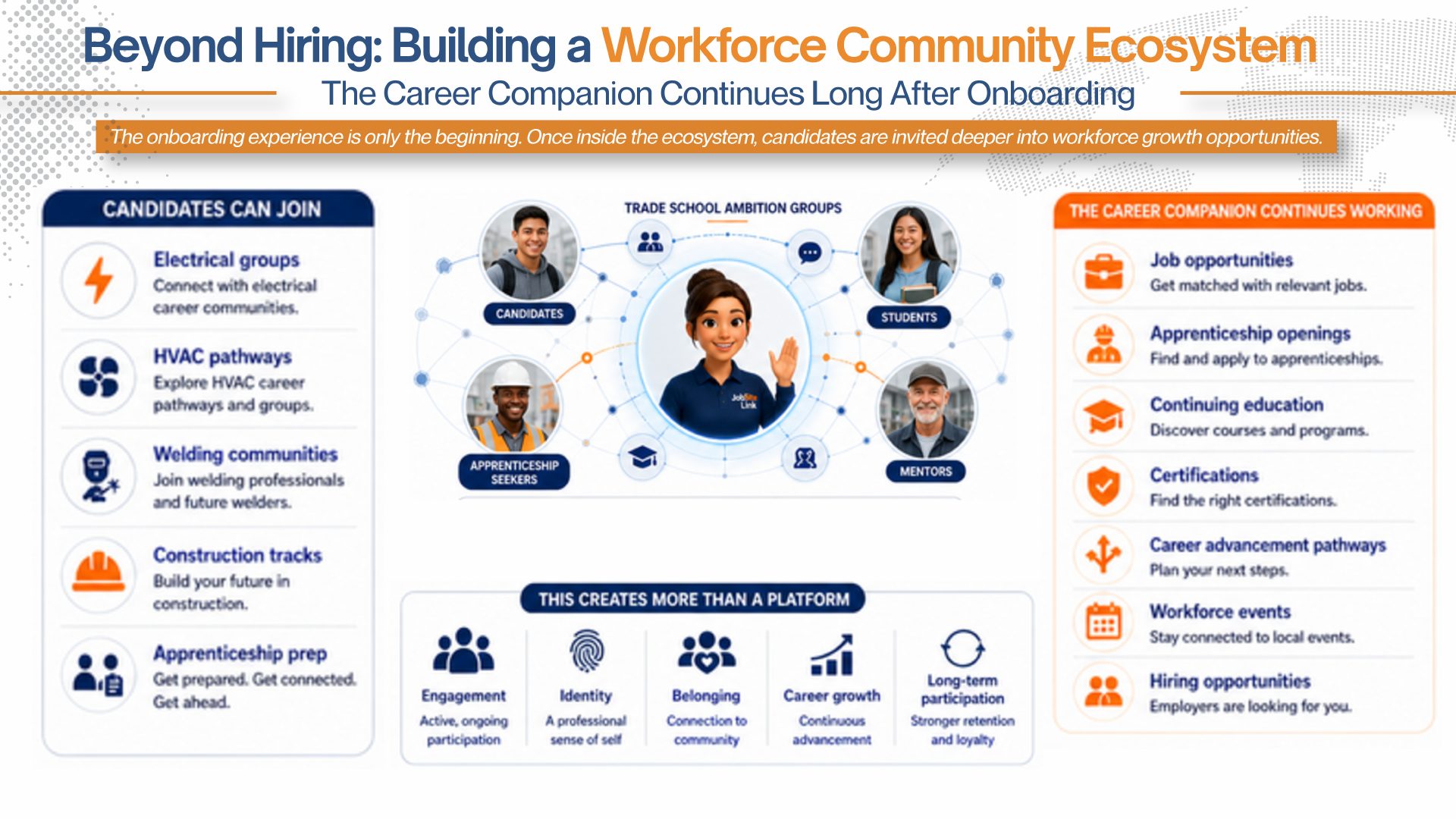
Roughly 80–90% of the curriculum is standardized across every partner. Customization happens in the final phases, where local trades, local unions, and local employers shape the participant’s actual pathway. It launches inside JobSite Link, in institutions, in September.
What I’m asking institutional leaders to see
For funders, corrections leadership, and policymakers, the implementation math is what should hold your attention.
JobSite Link is a low-cost entry. Zero facilities investment. It runs inside what your institution already has. The footprint is small enough that a county or a single facility can pilot it without a capital request, and the program scales by adding trade clusters, not by adding walls.
What that buys you is broad-trade access for a population that’s currently funneled into one or two narrow tracks — if any. It buys you employer-aligned skill development on a runway long enough to actually take, starting 18 months before release. It buys you a credible, lived-experience-led program that hiring partners take seriously because the person who built it isn’t theorizing about reentry from a podium.
I’m not asking you to fund a hope. I’m asking you to fund a model I’ve already proven on myself, structured so it can scale to the men and women coming home behind me.
The ask
If you run a facility, a foundation, a reentry portfolio, a workforce program, or a corrections agency — book time with me before the September launch. I’ll show you exactly how JobSite Link plugs into your institution, what a pilot cohort costs, and what changes for the people in your custody when trade skills are on the table 18 months out instead of 18 days out.
I came home with a trade in my hands. The men and women coming home next deserve the same shot — and the institutions holding them have the power to decide whether they get it.
Let’s build the bridge they can walk across.